
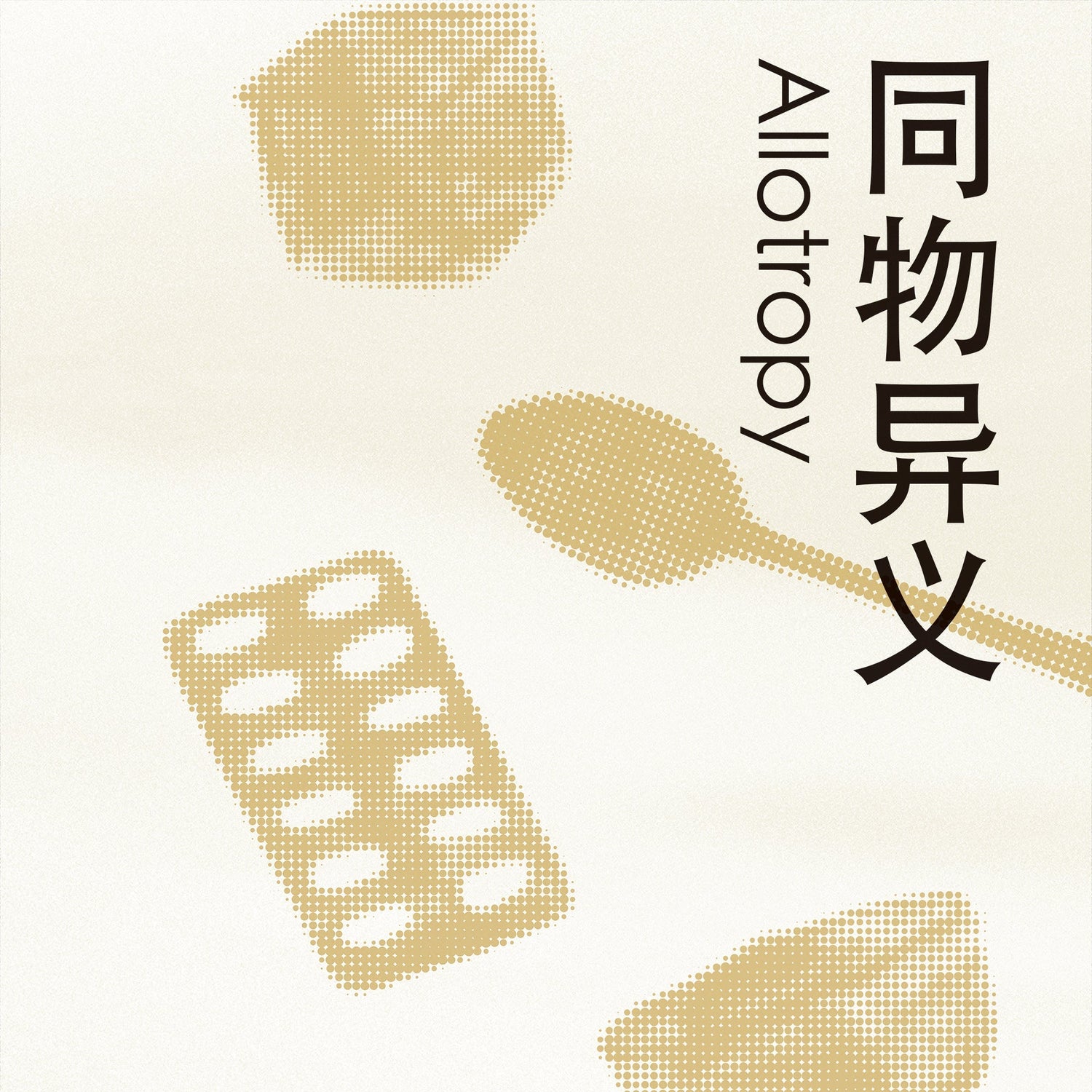
Metaphors of Everyday Objects in Chinese and British Cultural Contexts
This exhibition explores the differences in how everyday objects are perceived, emotionally invested in, and symbolically interpreted within Chinese and British cultural contexts. It brings together Chinese artists living in the United Kingdom and British artists, who reinterpret ordinary objects through the media and practices of applied art.
At the centre of Allotropy is the question: When the same object enters a different cultural context, do the metaphors it carries also change?
Objects can evoke entirely different associations and emotional structures within different cultural systems. A pill, for example, may signify healing and order in one context, while in another it may suggest pressure, dependency, or the anxieties of modern life. A spoon may represent family life and culinary culture, but it may also become an extension of power, labour, or memory. Pills, bottle caps, spoons, magnifying glasses, palm-sized tactile objects, and other small, ordinary items from daily life are used by the artists as points of departure. Through transformations of material, technique, and form, they are reinterpreted as craft objects, small-scale sculptures, and installations. Once removed from their original functions, these objects are no longer simply recognised through habit and prior experience. Instead, they invite renewed reflection on cultural experience, identity, and ways of seeing.
Allotropy, refers to the scientific phenomenon in which the same chemical element exists in different structural arrangements, resulting in distinct forms and properties. Curatorial Director Zhenxian Shi borrows this concept and translates it into a cultural discussion of everyday objects. When the same object enters different cultural environments, lived experiences, and systems of perception, it may, like an allotrope, acquire entirely different meanings beneath a seemingly similar surface.
The exhibition pays particular attention to the influence of cross-cultural experience on the interpretation of objects. For Chinese artists who have lived in the United Kingdom for extended periods, these objects often exist between two contexts. They carry emotional memories formed through an Eastern upbringing while continually being overlaid with new meanings acquired within Western society.
The works of the British artists, by contrast, more often approach these objects through local social and cultural conditions, patterns of consumption, and personal experience. When these two perspectives are placed alongside one another, the same object can generate multiple, and at times contradictory, systems of metaphor.
The exhibition therefore does not attempt to offer a single or definitive answer. Instead, it proposes an open way of looking and asks whether objects truly possess fixed meanings, or whether meaning is produced through culture, memory, and the individual viewer.
Presenting the exhibition in China also forms an important part of this enquiry. When encountering these works, Chinese audiences may experience a renewed sense of unfamiliarity towards objects they ordinarily consider familiar. This estrangement may reveal how their own cultural experiences shape their understanding of everyday things.
Through the contrast and encounter between Chinese and British cultures, the exhibition reconsiders how ordinary objects can become vehicles for cultural translation, identity formation, and emotional projection within a globalised world.
This is not only an exhibition about objects, but also an exhibition about looking. The most ordinary things may, in fact, conceal the deepest cultural differences.
Curatorial Director: Zhenxian Shi
Curator: Yiru Zhang
Supported by: Alsolike Gallery and Qi Art Space
Address: No. 5 Wufu Xiaolu, Jiang’an District, Wuhan, China
Opening Hours: 10:30–18:30
Dates: 13–17 July



Leave a comment
This site is protected by hCaptcha and the hCaptcha Privacy Policy and Terms of Service apply.