
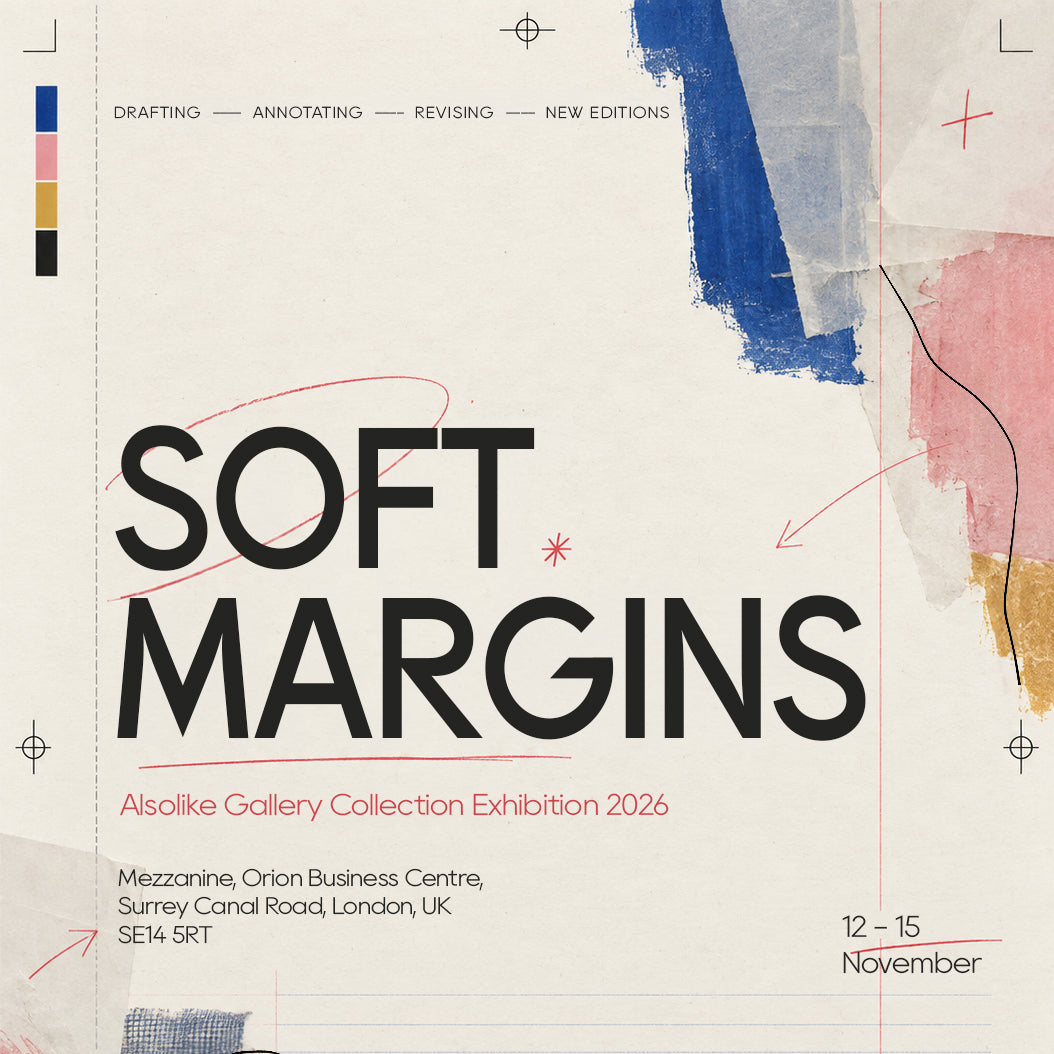
Alsolike Gallery Collections 2026
Exhibition Dates 12 - 15 November 2026
Venue Mezzanine Studio, Orion Business Centre, Surrey Canal Road, London, UK, SE14 5RT
Opening Hours and Admission 10AM - 4PM, Free Entry
Curatorial Director Yiru Zhang
Curator Weiwei Zhang
Exhibition Coordinator Song Yang

Soft Margins focuses on boundaries that are difficult to define clearly and remain in a constant state of change.
The exhibition brings together painting, photography, fabric, and mixed-media works to explore the shifting relationships between image and abstraction, body and environment, and private memory and collective experience. It considers how artists engage with personal experiences that are difficult to describe clearly. In these works, a memory may be transformed into colours and patterns; an emotion may leave traces through repeated acts of painting, stitching, or covering; and figures and everyday objects may be broken apart, concealed, or recombined.
The “boundaries” in the exhibition refer to how individuals distinguish themselves from the external world: what we choose to show others, and what we retain within images and materials. “Soft” suggests that this distinction is not fixed. Life experiences, family relationships, and cultural backgrounds continually reshape how people understand and represent themselves, as well as how they perceive others. These works resemble incomplete clues, allowing viewers to gradually approach the emotions and memories preserved within them through figures, colours, patterns, materials, and traces of the creative process.
The traditional “page margin” is usually understood as the area surrounding the main body of a text. It may appear to occupy a secondary position, yet annotations, corrections, personal responses, and different interpretations often accumulate precisely there. In Soft Margins, the “margin” becomes a space of possibility. It points to experiences that exist outside dominant historical narratives yet continue to persist through clothing, family objects, inherited patterns, oral histories, bodily gestures, and forms of handicraft. Here, “softness” is understood as the capacity to bend, hold, absorb, protect, and be repaired.
The exhibition raises the following questions:
What is left at the margins of dominant narratives?
What ways of seeing can emerge from the margins?
How does an experience change when it is placed on display?
Can the margin become an active position?

The exhibition borrows four actions from the processes of writing and editing—drafting, annotating, revising, and creating new versions—to further develop the metaphor of “Margins”. These chapters do not imply that the exhibition uses the process of editing a document as a way of understanding the artists’ creative practices. The four chapters form a clear editorial process: first, an experience is given visual form; then, a personal voice is added alongside an existing narrative; next, inherited images and interpretations are revised; and finally, different alternative versions are brought into view.
The works are displayed on the walls of the space, surrounding a large freestanding exhibition table, allowing visitors to move around the works and understand their constantly changing “page structure”.
Giving an experience its first visible form.
This chapter focuses on how artists develop the initial visual language of their work from memories, figures, everyday scenes, and objects. It includes:
Paintings drawn from personal memories
Portraits and self-portraits
Scenes of family or everyday life
The reuse of photographs, objects, and old images


Adding a personal voice beside an existing narrative.
Annotations usually appear beside the main text. They do not immediately replace it, but can add information, raise objections, or change the reader’s understanding of the text. This chapter focuses on how artists add their own positions and responses alongside family histories, cultural traditions, public images, or social ideas. It includes:
Responses to family photographs or historical images
Reinterpretations of cultural symbols, traditional patterns, and everyday objects
Works that place private experiences within public imagery


Changing what has already been pictured or understood.
This chapter focuses on covering, erasing, cropping, splicing, stitching, repetition, and redrawing. The artists continue to work on existing images, memories, and cultural materials. “Revision” also demonstrates that memory and identity are not fixed facts. They continually change over time and according to the storyteller and the context in which they are viewed. It includes:
Collage and the recombination of images
Cropping, repetition, and reworking in photography
The transformation of old textiles, clothing, or found objects


Making space for another version of the story.
Here, “new versions” means giving more space to content that was originally situated in the margins. New Editions is more appropriate than Publishing, because publishing can suggest that a work has been finalised, whereas new editions indicates that the story can continue to be revised. It includes:
Works that bring overlooked aspects of everyday life into focus
Works that reinterpret traditional forms or visual materials
Works that invite viewers to participate in the processes of viewing, arranging, or interpretation
The final layout will be developed after a site visit and once the participating works have been confirmed.


Leave a comment
This site is protected by hCaptcha and the hCaptcha Privacy Policy and Terms of Service apply.